Repair TipsLocal Guides
How to fix a running toilet and stop the water waste
A running toilet is usually one of three small parts failing, and it wastes water the whole time it runs. This guide shows how to find which part, fix it safely, and know when the problem is bigger than the tank.
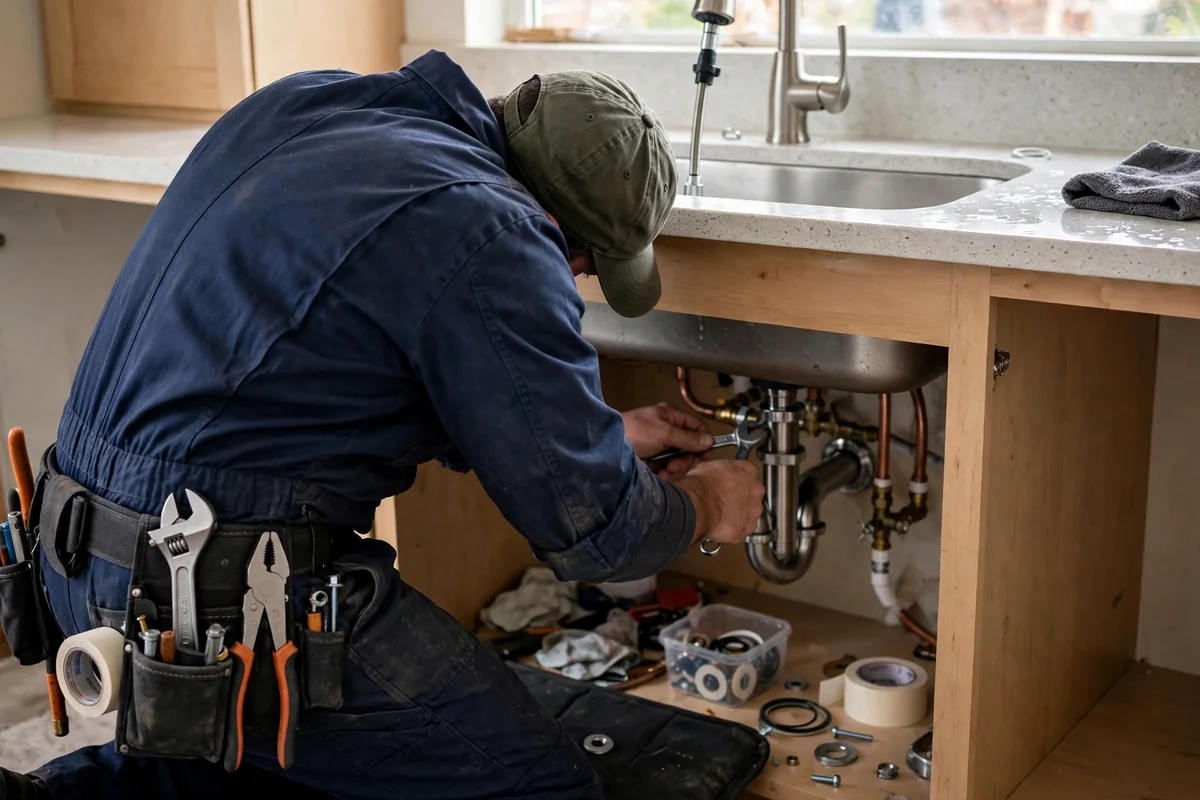
A toilet runs when water keeps entering the bowl or leaking from the tank into the bowl after the flush. The tank holds the clues: the water level, the flapper seal, and the fill valve behaviour.
Why your toilet keeps running after you flush
The usual causes are a flapper that no longer seals, a fill valve that does not shut off, a water level set above the overflow tube, or a cracked overflow tube. A flapper that is warped, swollen, or coated in mineral build-up lets tank water trickle into the bowl, so the fill valve tops the tank up again and again. A fill valve that sticks open does the same from the other side.
- Flapper: The rubber seal at the bottom of the tank. It warps, cracks, or gets coated in mineral film after 3 to 5 years, so it never fully closes.
- Flush valve seat: The plastic or brass rim the flapper rests on. Mineral build-up in Conyers leaves scale here, and even a brand-new flapper won't seal against a rough seat.
- Fill valve: The tall tower that refills the tank. A worn diaphragm or a float set too high sends water straight down the overflow tube.
- Flush handle chain: Too tight and it holds the flapper open. Too loose and it snags.
- Overflow tube: If the water level sits above the top of this tube, the tank drains continuously into the bowl.
How much water a running toilet wastes in Conyers
A running toilet can waste a large volume of water over days and weeks, because the leak never pauses, and the cost shows up on the water bill rather than on the floor. The exact volume depends on the leak rate, which is why the first step is to find the faulty part, not to guess the bill. A dye test, a few drops of food colouring in the tank, shows a flapper leak within minutes if colour appears in the bowl without flushing.
- Slow flapper leak: About 25 to 50 gallons/day = roughly 900 to 1,500 gallons/month.
- Moderate leak: Around 100 gallons/day = 3,000 gallons/month.
- Wide-open flapper: 200+ gallons/day = 6,000+ gallons/month.
Tools and parts you need for a running toilet repair
You need a replacement flapper matched to your toilet, a fill valve if yours sticks, a sponge and towel, and basic hand tools. No special equipment is needed, and no chemical product belongs in the tank: tank additives that promise cleaning can degrade rubber seals and make the problem worse. Buy the part after identifying the fault, not before.
- Adjustable pliers or a small wrench
- A sponge and a shallow cup or bowl
- A replacement flapper (bring the old one to the store - sizes vary)
- Optional: a full toilet repair kit with a new fill valve, flapper, and hardware (available at a hardware store; ask for a written price for any professional repair before work)
- Optional: a small piece of fine emery cloth or a nylon scrub pad for cleaning the valve seat
Step-by-step: how to fix a running toilet
First, shut off the toilet’s supply valve and flush to empty the tank. Second, inspect the flapper for warping or build-up, and check the water level against the overflow tube, which should sit about an inch below the tube’s top. Third, replace the faulty part, following the part maker’s instructions, and reconnect the chain with a little slack. Fourth, turn the water back on, let the tank fill, and watch for a full minute: the water should stop at the marked level and stay there.
Step 1: Shut off the water and drain the tank
Step 2: Diagnose the leak
Step 3: Replace the flapper
Step 4: Adjust the fill valve if the tank overfills
Step 5: Replace the fill valve if it won't shut off
Common mistakes that keep a toilet running
The common mistakes are replacing the fill valve when the flapper is the fault, setting the chain too tight so the flapper cannot seal, and setting the water level above the overflow tube so the tank drains itself forever. Another is ignoring a rocking toilet or a leak at the base, which is a wax seal or flange problem, not a tank problem, and needs a different repair.
- Skipping the seat cleaning. Mineral build-up film in Conyers is thick. Scrub it off or the new flapper won't seal.
- Over-tightening the chain. It should have about half an inch of slack. Too tight holds the flapper open.
- Using the wrong flapper size. A 2-inch flapper in a 3-inch valve leaks from day one.
- Ignoring the fill valve. If the flapper is new and the toilet still runs, the fill valve is the problem.
- Setting the water level too high. Water above the overflow tube drains straight into the bowl, forever.
- Forgetting to check the shutoff valve. If it won't close, you can't do the repair safely.
When to call a professional
Call during business hours if the toilet rocks, leaks at the base, has a cracked tank or bowl, or keeps running after both the flapper and the fill valve have been replaced correctly. Stop and call sooner if water reaches the floor below or the subfloor feels soft, and shut off the toilet’s supply in the meantime.
Frequently Asked Questions
Why does my toilet keep running after I flush?
Usually a flapper that no longer seals, a fill valve that does not shut off, or a water level set above the overflow tube.
How do I test the flapper?
Put a few drops of food colouring in the tank and wait without flushing. Colour in the bowl means the flapper is leaking.
Can a running toilet really waste much water?
Yes. A leak that never pauses adds up over days and weeks, and it shows up on the water bill rather than on the floor.
Should I put cleaning chemicals in the tank?
No. Tank additives can degrade rubber seals and make the fault worse. Fix the part instead.
When is a running toilet not a tank problem?
When the toilet rocks or leaks at the base, which points to the wax seal or flange, or when the tank or bowl is cracked.
Get help with Plumbing in Conyers
If your toilet keeps running after the tank checks in this guide, call SoCo Plumbers during business hours, Monday–Friday 9 AM–5 PM, at +1 770-897-1640, and describe which part you checked and what you found.
If the toilet keeps running after the checks above, see Toilet Repair and Installation in Conyers.