Repair TipsLocal Guides
Why is my sink draining slowly in Olde Town Conyers
A slow sink in Olde Town Conyers is usually grease, soap scum, or hair narrowing an older branch, but the district’s older laterals and mature roots mean a slow sink is also worth checking against the rest of the house before it is treated as a single-fixture problem.
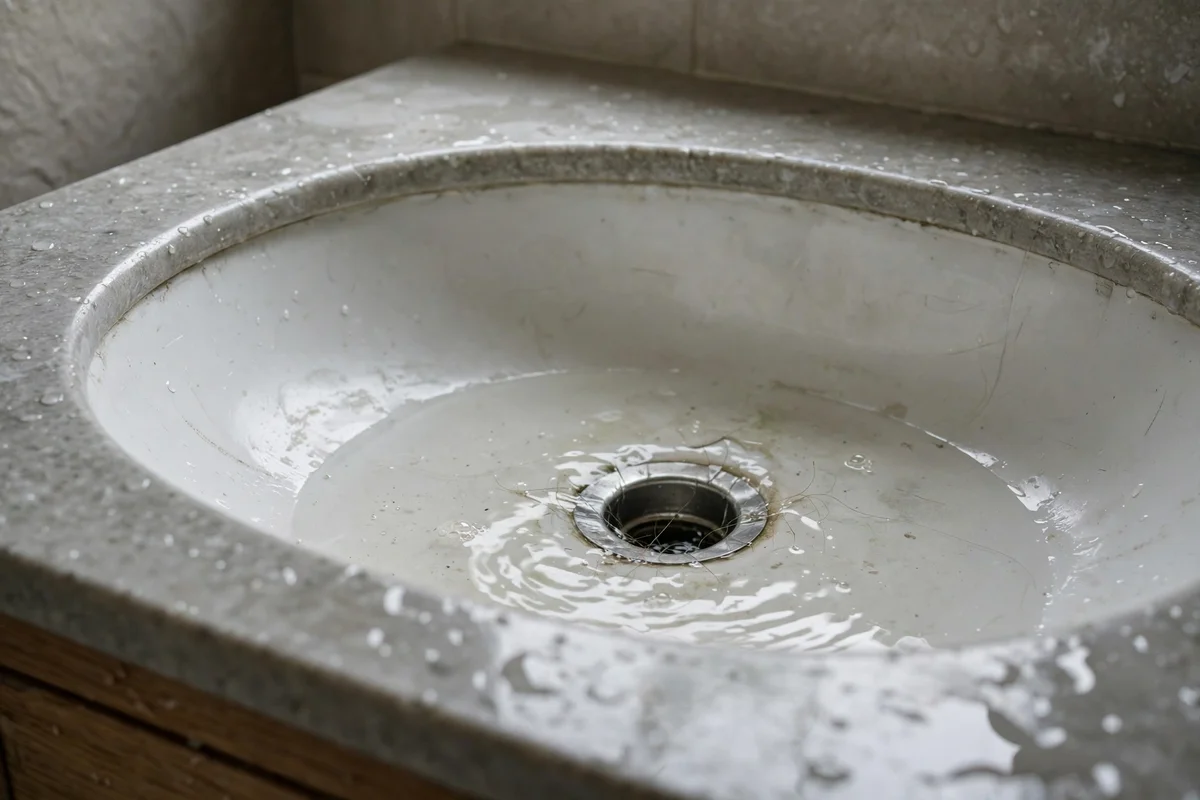
Start with the pattern, because it decides the fix. One slow sink is a trap or branch problem; several slow fixtures together point to a shared branch or the main lateral, and that is a different job.
The short answer: why your sink drains slowly in Olde Town Conyers
Your sink drains slowly because grease, soap scum, hair, or food waste has narrowed the trap or the branch, and in an older Olde Town home the branch itself may be corroded or scaled, which narrows it further. Mechanical clearing, boiling water for grease, a plunger, and a snake, clears most single-fixture cases without chemicals.
What causes a slow draining sink in Olde Town Conyers GA?
The causes are grease that cools and coats the branch, soap scum and hair in bathroom sinks, food waste in kitchen sinks, and, in older homes, corrosion and scale inside the branch itself. A sink that slows gradually over months points to build-up; a sink that slows suddenly after a single event points to an object or a sudden blockage in the trap.
Kitchen sink draining slowly Olde Town Conyers
Bathroom sink slow drain Olde Town Conyers GA
Vent and trap problems
How do I fix a slow sink drain in Olde Town Conyers Georgia?
First, remove standing water and check the trap for debris if you can do so without disturbing corroded fittings. Second, pour boiling water to melt grease, then plunge with a flange plunger, keeping the seal tight and the overflow covered where the sink has one. Third, if the sink stays slow, a manual snake reaches further down the branch. If several fixtures slow together, stop and call during business hours, because the problem is likely in a shared branch or the main lateral.
- Boiling water. Two quarts of boiling water poured slowly down the drain will melt light grease. Do this once, wait five minutes, then repeat. It works on grease and soap scum, not on hair.
- Plunger. A cup plunger - not a flange plunger - works best on a sink. Block the overflow hole with a wet rag, fill the basin with two inches of water, and plunge 15 to 20 times with a firm seal.
- Remove the P-trap. Put a bucket underneath, unscrew both slip nuts by hand, and pull the trap off. Clean it out with a bottle brush. This catches 70 percent of bathroom clogs and a good share of kitchen ones.
- Snake the branch line. A 25-foot hand snake from any Conyers hardware store will clear the first section of pipe past the trap. Feed it in, crank clockwise, and pull it back slowly.
- Enzyme drain cleaner. If the pipe is coated but not blocked, an enzyme cleaner used overnight for three nights will eat the organic film. It is slow but it does not damage pipes.
Why older Olde Town Conyers homes clog more often
Olde Town Conyers has a lot of housing stock built between the 1940s and the 1980s, and that plumbing was not designed for modern use. The original drain lines are often 1.25-inch galvanized steel or cast iron, both of which rust and scale on the inside. A 1.25-inch galvanized pipe that has been in service for 50 years might have an effective diameter of three-quarters of an inch.
Cast iron is worse in a different way. It rusts from the inside out, creating a rough, pitted surface that grabs every bit of soap scum and hair that passes through. We see this constantly in the blocks around the Olde Town Conyers area and along the streets near the courthouse square. Homeowners there tell us the same thing: the sink has always been a little slow, and now it is worse.
Galvanized supply lines also fail in these homes, which is a separate but related problem. If you are already dealing with rusty water or low pressure on top of the slow drain, it is worth having the whole system looked at. Our plumbing repairs Conyers GA team can tell you in one visit whether you are looking at a single clog or a pipe that is at the end of its life.
Tree roots are the other Olde Town Conyers specialty. The older neighborhoods have mature oaks, pines, and magnolias, and their roots find the smallest crack in a sewer lateral. A root intrusion starts as a slow drain in the lowest fixture in the house - usually a basement sink or a first-floor bathroom - and grows into a full backup. If your slow drain comes with gurgling from other fixtures or a sewer smell, that is a lateral problem, not a sink problem.
Common mistakes that make a slow drain worse
The common mistakes are using a chemical cleaner, which can damage older pipe and leave caustic liquid in the trap; forcing a corroded trap fitting until it breaks; and clearing the same sink repeatedly without checking whether other fixtures are slow too. Another is ignoring a sink that slows together with a tub or toilet, which is a main-line symptom, not a sink symptom.
- Using chemical drain openers repeatedly. Each dose leaves residue that catches more debris. Over a year, you can turn a partial clog into a hard, chemical-resistant plug.
- Pouring grease down the drain "with hot water." The hot water only carries the grease further down the pipe before it cools. It still solidifies.
- Running the disposal as a fix. If the drain is already slow, the disposal just pushes water and debris into a pipe that cannot handle it. You risk backing up into the other basin.
- Ignoring a second slow fixture. One slow sink is a local clog. Two slow fixtures on the same floor means the blockage is in the branch line or the main.
- Using a drain snake too aggressively. Cranking a hand snake hard against a cast iron trap can crack the trap or push the clog deeper. Slow and steady wins.
When to call a professional
Call during business hours if the sink stays slow after mechanical steps, if several fixtures slow together, if there is a sewer smell, or if a trap fitting is corroded and will not move. Stop and call sooner, in the safety sense, if sewage backs into the home.
Frequently Asked Questions
Why is my sink draining slowly in Olde Town Conyers?
Usually grease, soap scum, or hair narrowing the trap or branch, and in older homes, corrosion and scale inside the branch itself.
How do I fix a slow sink drain myself?
Check the trap, pour boiling water for grease, plunge with a flange plunger, and use a manual snake if it stays slow. No chemical cleaners.
Why do older Olde Town homes clog more often?
Mixed-era older branches corrode and scale from the inside, and mature roots enter older laterals, so a slow sink may be part of a wider problem.
When is a slow sink a main-line problem?
When several fixtures slow together, or a sink slows together with a tub or toilet. That points to a shared branch or the main lateral.
Should I use a chemical drain cleaner on a slow sink?
No. Chemical cleaners can damage older pipe and leave caustic liquid in the trap, and they do not fix a main-line or root problem.
Get help with Plumbing in Conyers
If your Olde Town sink stays slow after the mechanical steps in this guide, call SoCo Plumbers during business hours, Monday–Friday 9 AM–5 PM, at +1 770-897-1640, and note whether any other fixture is slow too.
If the sink keeps draining slowly, see Drain Cleaning in Conyers.