Repair TipsLocal Guides
Why does my water heater run out of hot water so fast
Hot water that dies in five minutes usually has one of six causes, and they are not equally likely. Sediment and a failed lower element lead the list, and each cause has a different test, so guessing wastes the visit.
Start with the pattern, because it narrows the cause before any panel is opened. Does the water start hot and fade, start lukewarm, or run hot at one tap and cold at another? Each pattern points somewhere different.
Why does my water heater run out of hot water in Conyers GA?
The six causes, ranked by how often they appear, are sediment build-up, a failed lower heating element, a broken dip tube, an undersized tank for the household, a thermostat set too low or failing, and, for tankless units, a flow rate above the unit’s capacity. Sediment insulates the bottom of a tank, so the burner or element heats sediment instead of water; a failed lower element leaves only the upper element working, so the tank delivers a fraction of its capacity.
The six reasons hot water dies fast (ranked by how often we see them)
Sediment: rumbling or popping, slow recovery, and a tank that feels hot at the top and cool below. Lower element failure: hot water for a short shower, then cold, because only the top of the tank is heated. Dip tube failure: cold water mixes at the top of the tank instead of being delivered to the bottom, so hot water fades fast. Undersized tank: a household that has grown past the tank’s capacity, where every busy morning ends the same way. Thermostat: a setting below the household’s need, or a thermostat that no longer holds temperature. Tankless flow: simultaneous draws above the unit’s rated flow, especially in winter.
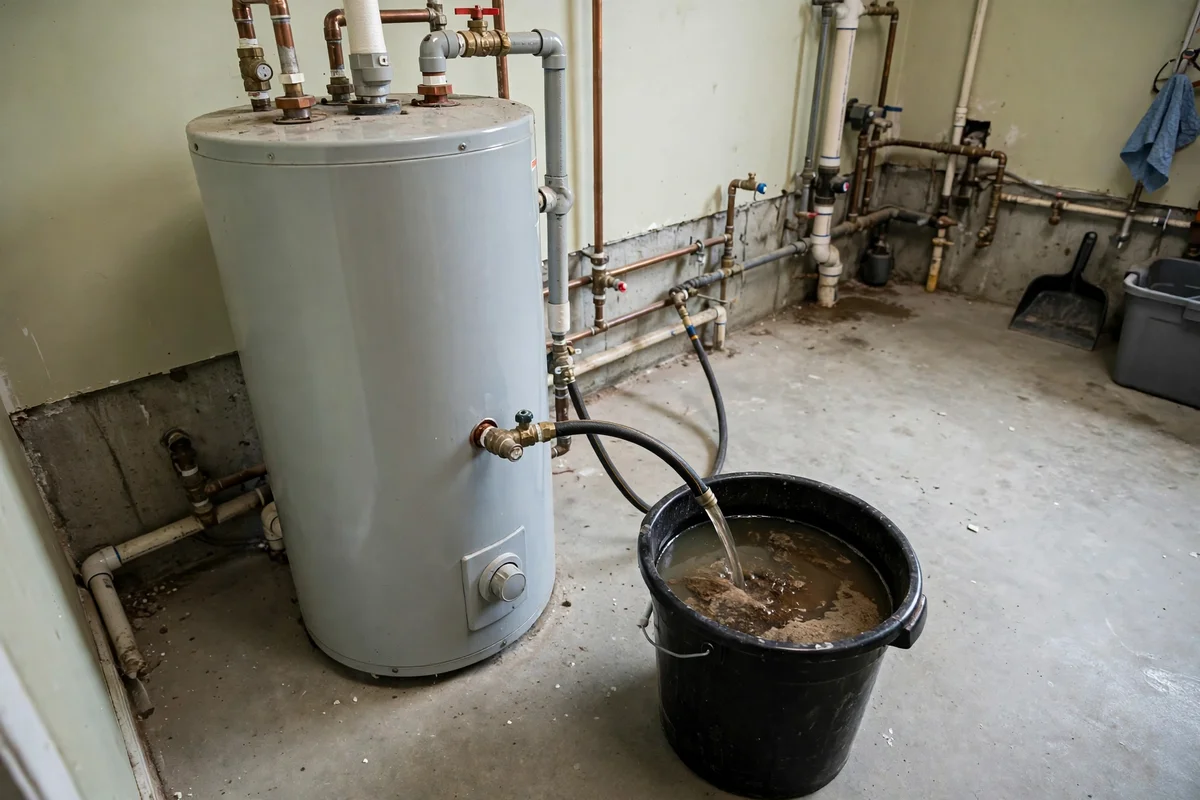
- Sediment on the tank floor. Dissolved minerals settle out and bake onto the bottom of the tank. That layer insulates the water from the burner or element.
- Broken dip tube. A small plastic tube that carries cold water to the bottom of the tank. When it cracks, cold water dumps into the hot water at the top and you feel it in the shower within seconds.
- Failed lower heating element (electric). Most electric tanks have two elements. The lower one does the heavy lifting. When it dies, you get a few gallons of hot water and then nothing.
- Thermostat or gas control valve failure. The tank heats, but not to the set temperature, so the first shower drains what little hot water exists.
- Undersized tank for the household. Common after a family grows or a teenager starts taking 15-minute showers.
- Crossed plumbing or a failed mixing valve. Less common in single-family homes, more common in condos and remodels.
Sediment in water heater Conyers homes: the number one culprit
Sediment is the number one culprit because it builds silently in every tank and shows only when recovery slows. Flushing the tank through its drain valve removes loose sediment, but a tank with heavy, hardened build-up may not recover fully, and flushing a very old tank can disturb a drain valve that then will not reseal. Note the unit’s age before flushing, and call during business hours if the drain valve is seized or the tank leaks.
- Year 1-2: barely noticeable, maybe 10% less hot water.
- Year 3-4: 30-40% less hot water, popping sounds start.
- Year 5+: 50-70% less hot water, and the tank is now a rust risk.
How long should hot water last in Conyers GA?
A correctly sized tank should cover the household’s peak: back-to-back showers, a dishwasher, and laundry overlapping, without fading. If a tank that once managed now fades, the cause is a fault, sediment, element, or dip tube, rather than size. If it never managed, the cause is sizing, and the fix is a larger tank or a correctly sized tankless unit, not a repair.
- 40-gallon tank: 8-12 minutes of continuous shower, one fixture at a time.
- 50-gallon tank: 12-18 minutes of continuous shower.
- 75-gallon tank: 20-28 minutes.
- Tankless (199,000 BTU): unlimited, as long as you stay under its flow rating - usually 2-3 fixtures at once.
How do I fix a water heater that runs out of hot water in Conyers?
Homeowner-safe steps are checking the thermostat setting, flushing loose sediment if the drain valve works freely, and noting the pattern of failure for the visit. Element, dip tube, and thermostat replacement, and any gas or electrical work, belong to a professional during business hours. Do not open an electrical panel or a gas valve to chase hot water.
Step 1: Confirm the tank is actually heating
Step 2: Listen for popping or rumbling
Step 3: Check the dip tube
Step 4: Test the elements and thermostats
Step 5: Verify the gas control valve on gas tanks
Common mistakes we see homeowners make
The common mistakes are turning the thermostat to maximum to compensate, which scalds and does not fix sediment or a failed element; flushing a tank with a seized drain valve; and replacing a tank that only needed an element. Another is sizing a replacement to the old unit’s label rather than to the household’s peak demand.
- Turning the thermostat to 160°F to "get more hot water." That does not add capacity. It adds scald risk and accelerates sediment baking onto the tank floor.
- Flushing the tank yourself with a garden hose and no shutoff plan. The drain valve on a 10-year-old tank often will not close again. Then you have a leak.
- Ignoring the anode rod. That small rod is what keeps the inside of your tank from rusting. Once it is gone, the tank is on a clock.
- Replacing the element without flushing. The new element burns out in six months because the sediment that killed the first one is still there.
- Buying a bigger tank when the old one is fine. If your 50-gallon tank gave you 18 minutes last year and 6 minutes now, the tank is not too small. It is broken.
Should I repair or replace my water heater in Conyers Georgia?
Repair when the fault is a single part, element, dip tube, or thermostat, and the tank itself is sound and within its expected life. Replace when the tank leaks, when sediment has hardened beyond flushing, or when the household has outgrown the capacity. As Oct-2026 Atlanta market data, not SoCo Plumbers’ prices, a standard tank installed runs $800–$2,000 (Angi Atlanta flat rate, July 2026) and tankless gas $1,406–$3,902 (Angi national, August 2026, average $2,641).
- Water heater flush: ask for a written price before work begins.
- Lower element replacement: ask for a written price before work begins.
- Dip tube replacement: ask for a written price before work begins.
- Thermostat replacement: ask for a written price before work begins.
- Gas control valve replacement: ask for a written price before work begins.
- New 50-gallon gas tank installed: as Oct-2026 Atlanta market data, not SoCo Plumbers’ prices, a standard tank installed $800–$2,000 (Angi Atlanta flat rate, July 2026).
- New 50-gallon electric tank installed: as Oct-2026 Atlanta market data, not SoCo Plumbers’ prices, a standard tank installed $800–$2,000 (Angi Atlanta flat rate, July 2026).
- Tankless unit installed: as Oct-2026 Atlanta market data, not SoCo Plumbers’ prices, tankless gas $1,406–$3,902 (Angi national, August 2026, average $2,641).
When to call a professional
Call during business hours for element, dip tube, or thermostat work, for a leaking tank, or for any gas or electrical-adjacent fault. Stop and call sooner, in the safety sense, for a gas smell, evacuate and call 911 or your gas utility first, or for water near electrics.
Frequently Asked Questions
Why does my water heater run out of hot water so fast?
Most often sediment build-up or a failed lower element, followed by a broken dip tube, an undersized tank, or a failing thermostat.
How do I know if it is sediment?
Rumbling or popping from the tank, slow recovery, and a tank that feels hot at the top and cool below all point to sediment.
Can a dip tube cause fast hot-water loss?
Yes. A broken dip tube lets cold water mix at the top of the tank instead of reaching the bottom, so hot water fades quickly.
Should I repair or replace my water heater?
Repair a single-part fault in a sound tank; replace a leaking tank, one with hardened sediment, or one the household has outgrown.
What does a replacement cost?
As Oct-2026 Atlanta market data, not SoCo Plumbers’ prices, a standard tank installed $800–$2,000 (Angi Atlanta flat rate, July 2026), tankless $1,406–$3,902 (Angi national, August 2026, average $2,641).
Get help with Plumbing in Conyers
If your hot water fades fast in a Conyers home, call SoCo Plumbers during business hours, Monday–Friday 9 AM–5 PM, at +1 770-897-1640, with the pattern, the unit’s age, and whether the tank rumbles or pops.
If the heater itself is the problem, see Water Heater Repair in Conyers.