Local GuidesWater Heaters
Tankless vs tank water heaters guide for Conyers homes
Tank wins on upfront cost and simplicity; tankless wins on space and endless hot water, provided it is sized and supplied correctly. The right choice for a Conyers home depends on peak demand, fuel, venting, and how long you plan to stay.
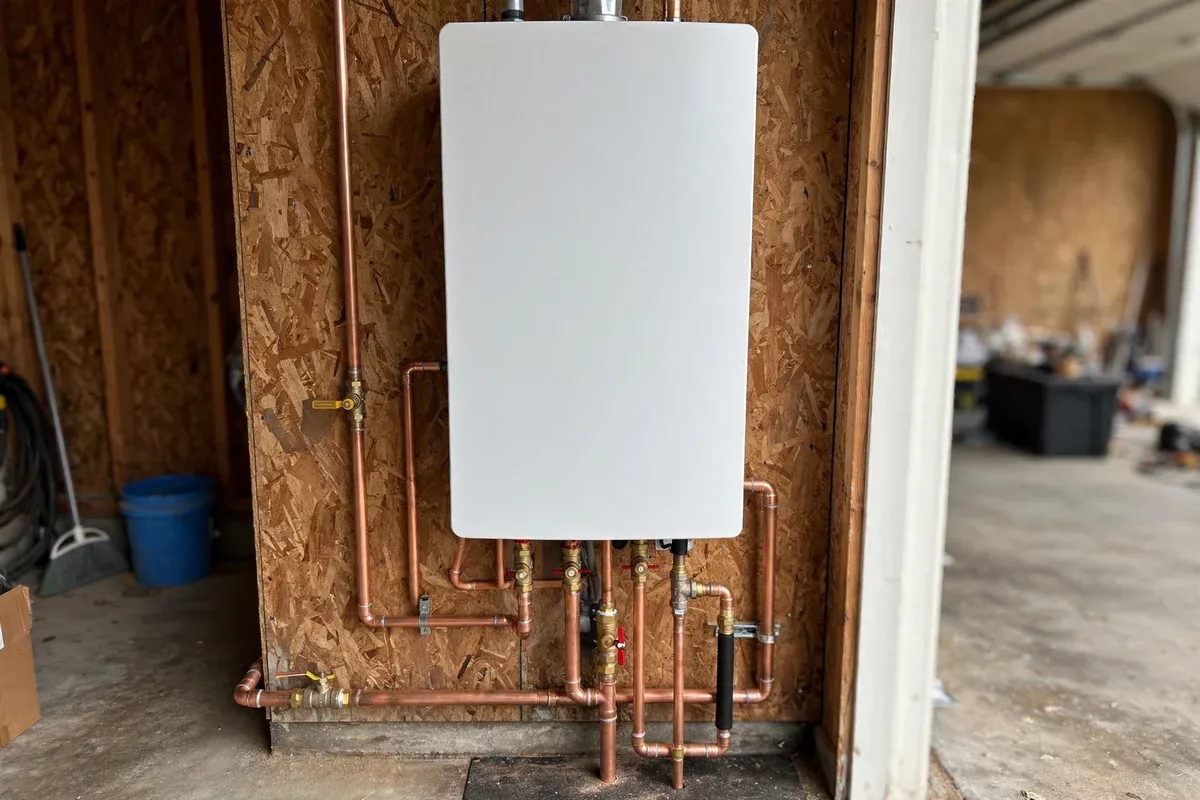
The two systems solve different problems. A tank stores hot water and reheats it as it is used; a tankless unit heats water only when a tap opens. That single difference drives every trade-off below.
The short answer for Conyers homeowners
For a smaller household with modest simultaneous demand, a tankless unit can work well and frees floor space. For a larger household that runs showers, laundry, and a dishwasher at once, a correctly sized tank, or a larger tankless unit with the gas or electrical capacity to feed it, is the safer choice. Sizing to peak demand, not to the old unit’s label, is what prevents cold showers either way.
How each system actually works
A tank heater keeps 40 or 50 gallons hot at all times, reheating as water is drawn, which means standby heat loss but instant availability up to the tank’s capacity. A tankless heater fires only on demand and heats water as it passes through, which means no standby loss but a flow limit: exceed it, and the water runs cooler. Incoming water temperature in winter lowers the tankless output further, which is why a unit sized for summer can disappoint in January.
Upfront cost: tankless vs tank in Conyers
As Oct-2026 Atlanta market data, not SoCo Plumbers’ prices — call for a written price before work. a standard 40 to 50 gallon tank installed runs $800–$2,000 (Angi Atlanta flat rate, July 2026), while tankless runs $1,406–$3,902 (Angi national, August 2026, average $2,641). Tankless also needs gas or electrical capacity and venting, which can add to the job if the home does not already have them. Ask for the full scope, including venting and any capacity work, in the written price.
- Tank, gas, 40–50 gallon: as Oct-2026 Atlanta market data, not SoCo Plumbers’ prices, a standard tank installed $800–$2,000 (Angi Atlanta flat rate, July 2026).
- Tank, electric, 40–50 gallon: as Oct-2026 Atlanta market data, not SoCo Plumbers’ prices, a standard tank installed $800–$2,000 (Angi Atlanta flat rate, July 2026).
- Tankless, gas, whole-home: as Oct-2026 Atlanta market data, not SoCo Plumbers’ prices, tankless gas $1,406–$3,902 (Angi national, August 2026, average $2,641).
- Tankless, electric, point-of-use: priced per unit by scope; ask for a written price before work begins.
Operating costs and efficiency in Georgia
Tankless units use less energy in standby because they do not keep a tank hot, but the saving depends on use: a household that draws little hot water saves more than one that draws constantly. Tanks cost less to buy and to maintain, and their parts are simpler. Neither system saves money if it is undersized, because an undersized unit runs constantly or leaves the household short.
Hot water demand: sizing for a Conyers household
Size to the household’s peak: count the showers, taps, and appliances that run at the same time on a busy morning, and size the tank or the tankless flow rate to that peak, not to the average. A Conyers home with two bathrooms and a dishwasher running together needs a different answer from a one-bathroom home, and a growing household should size for the household it will be, not only the one it is.
- Showerhead: 1.5-2.5 GPM
- Kitchen faucet: 1.0-1.5 GPM
- Dishwasher: 1.0-1.5 GPM
- Washing machine: 1.5-2.0 GPM
- Bathroom faucet: 0.5-1.0 GPM
Lifespan, maintenance, and repairs
Tanks typically last around a decade or so depending on water, sediment, and maintenance, while tankless units can last longer when descaled regularly, especially in harder water. Rockdale County’s surface water is generally soft, which helps both systems, but sediment still builds in tanks, and tankless units still need descaling on a schedule. Ask what maintenance each option needs and what it costs over the unit’s life, not just on day one.
What to watch out for
Watch for a tankless unit quoted without a gas or electrical capacity check, a tank quoted without a venting check, and either system quoted without a peak-demand calculation. Watch too for a lifespan promise that ignores descaling or sediment flushing, because maintenance is what actually delivers the lifespan.
- Ignoring the gas line. A whole-home tankless unit needs 199,000 BTU/hr. Many Conyers homes have a 1/2-inch line that maxes out around 120,000 BTU/hr. That is an upgrade most quotes forget to mention; ask for it in the written price before work begins.
- Skipping the vent. Tankless units need either a stainless steel horizontal vent or PVC (for condensing models). You can't reuse the old tank's B-vent.
- No freeze protection. Conyers gets a handful of hard freezes each winter. An exterior-mounted tankless unit without a freeze-protection kit will crack its exchanger. We see this every January.
- Electric tankless on a 100-amp panel. Most whole-home electric tankless units need 150-200 amps. If your panel is already full, that's a service upgrade.
- No maintenance plan. A tankless unit that never gets descaled is a 10-year unit pretending to be a 20-year unit.
When to call a professional
Call during business hours to size and install either system, and for any gas, venting, or electrical-adjacent work. Do not attempt gas or venting work yourself, and stop and call sooner, in the safety sense, for any gas smell: evacuate and call 911 or your gas utility first.
Frequently Asked Questions
Is tankless better than tank for a Conyers home?
It depends on peak demand, fuel, venting, and space. Tankless wins on space and endless hot water when sized correctly; tank wins on upfront cost and simplicity.
How much does a water heater replacement cost?
As Oct-2026 Atlanta market data, not SoCo Plumbers’ prices, a standard tank installed $800–$2,000 (Angi Atlanta flat rate, July 2026), tankless $1,406–$3,902 (Angi national, August 2026, average $2,641).
Does a tankless heater need special gas or electrical supply?
Often, yes. Tankless units need enough gas or electrical capacity and correct venting, which should be checked before any quote is agreed.
How long does each type last?
Tanks typically last around a decade depending on sediment and maintenance; tankless units can last longer when descaled on schedule. Maintenance delivers the lifespan.
Will a tankless unit run out of hot water?
Not by capacity, but by flow: exceed its flow rate with too many simultaneous draws, especially in winter, and the water runs cooler. Sizing to peak demand prevents it.
Get help with Plumbing in Conyers
If you are choosing between tank and tankless for a Conyers home, call SoCo Plumbers during business hours, Monday–Friday 9 AM–5 PM, at +1 770-897-1640, with the household size, the bathrooms, and the fuel available, and ask for the sizing calculation in writing.
To compare installed options for your home, see Tankless Water Heater Services in Conyers.