Repair TipsLocal Guides
How to install a new faucet without calling a plumber
A faucet swap is one of the most doable home plumbing jobs, provided the shutoffs work and the drain is left alone. This guide covers the job end to end, and the points where stopping and calling is the right move.
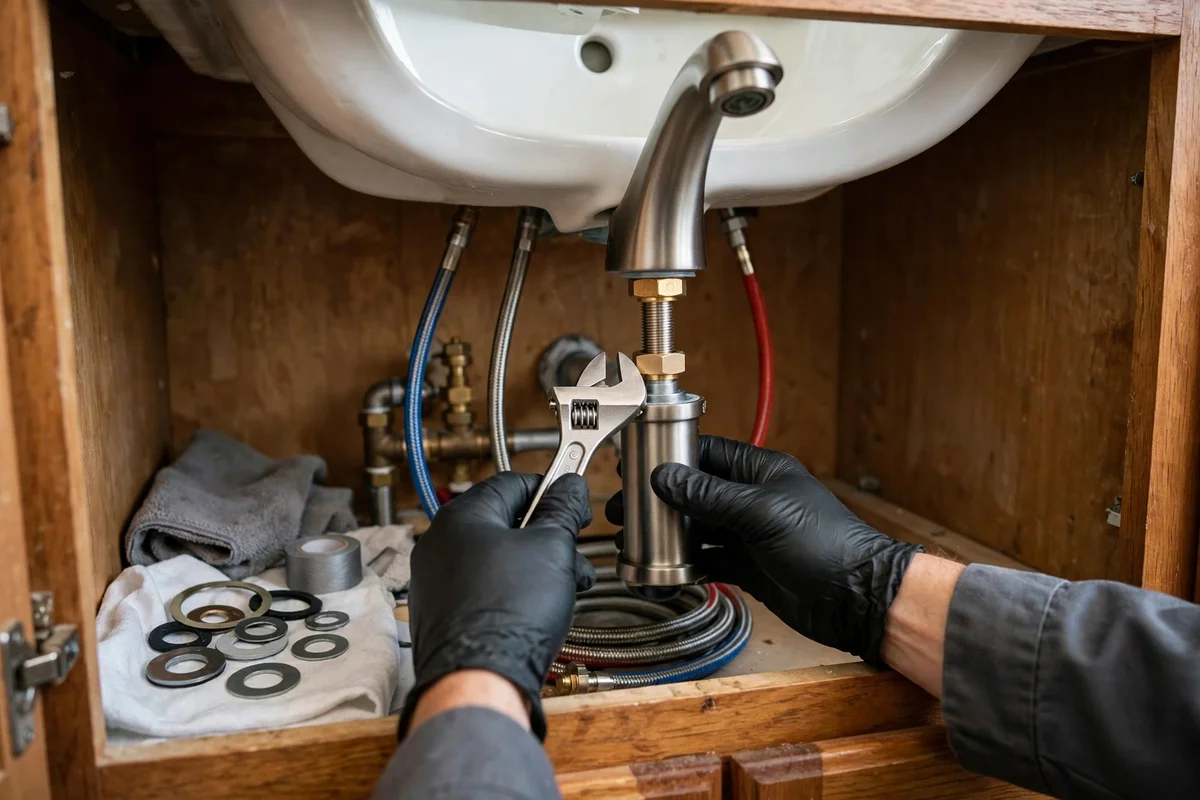
A standard faucet replacement is a disconnect, a swap, and a careful leak check. The job stays small only if the shutoff valves under the sink actually close, which is the first thing to test.
What You Need Before You Start
You need the new faucet and its supply lines, a basin wrench for the tight space behind the sink, an adjustable wrench, a bucket and towels, and plumber’s putty or the seal the faucet maker specifies. Check the hole count and spacing on your sink before buying, because a three-hole faucet does not fit a single-hole sink without a cover plate.
Step-by-Step: How to Install a New Faucet
First, shut off both hot and cold supplies under the sink and open the faucet to confirm the water stops; if a shutoff does not close fully, stop and call, because forcing it can break the valve. Second, disconnect the supply lines and the old faucet’s mounting nuts, and lift the old unit out. Third, set the new faucet with its seal, tighten the mounting nuts evenly without cracking the sink, and connect the supply lines. Fourth, turn the water on slowly, check every connection for drips, and run both hot and cold for a minute.
- Disconnect the supply lines. Use the basin wrench on the nuts connecting the braided lines to the shutoff valves. Hold the valve body with your other hand so you do not twist the pipe in the wall.
- Remove the old faucet. From under the sink, loosen the mounting nuts on the faucet shank. On a three-hole setup, the sprayer hose and soap dispenser come out too. If the nuts are rusted, hit them with penetrating oil and wait 10 minutes.
- Clean the deck. Scrape old putty and mineral buildup off the sink surface. A plastic scraper will not scratch stainless or porcelain.
- Set the new faucet. Run a 1/4-inch bead of plumber's putty or silicone around the base, feed the supply lines and sprayer hose through the hole, and press the faucet down. Have someone hold it from above while you tighten the mounting nuts from below.
- Connect the supplies. Wrap the shutoff valve threads with two to three turns of Teflon tape. Hand-tighten the supply line nuts, then snug them a quarter turn with the wrench. Do not crank down on braided lines - you will crush the washer.
- Reconnect the drain and sprayer. Hand-tighten the slip nuts on the P-trap, then a quarter turn with pliers. Clip the sprayer hose to the weight or guide per the manufacturer's diagram.
- Test. Open the angle stops slowly. Let the faucet run two minutes, then check every connection under the sink with a dry paper towel. Any moisture means another quarter turn.
How Long Does It Take to Install a Faucet in Conyers Georgia?
For a straightforward swap with working shutoffs, allow about ninety minutes including the leak check. Seized shutoffs, corroded supply lines, or a sink that needs resealing can double that, and any of those is a reasonable point to stop and call during business hours rather than forcing a fitting.
Common Mistakes to Avoid
The common mistakes are overtightening plastic supply nuts until they crack, skipping the leak check under pressure, and reusing old supply lines that are already corroded. Another is disturbing the drain trap while working on the faucet and then finding a new leak at the trap. Work on the faucet only, and check the trap afterwards.
When to Call a Professional
Call during business hours if a shutoff will not close, a supply line is corroded, the sink or countertop is damaged, or the job involves moving supply lines, electrical-adjacent work, or a wall-hung or freestanding fixture. Stop if water cannot be shut off at all and shut the home’s main instead.
Frequently Asked Questions
Can I install a faucet myself?
Yes, if the shutoffs work, the hole count matches, and no supply lines need moving. Seized shutoffs or corroded lines are a reason to call.
What tools do I need for a faucet install?
A basin wrench, an adjustable wrench, a bucket and towels, and the seal the faucet maker specifies, plus the new faucet and supply lines.
How long does a faucet install take?
About ninety minutes for a straightforward swap with working shutoffs, longer if shutoffs or supply lines are seized or corroded.
What if the shutoff valve will not close?
Stop and call. Forcing a seized shutoff can break it, and the job then needs the home’s main shut off and a valve replacement.
Should I reuse the old supply lines?
No, if they are corroded or stiff. New supply lines are part of a reliable install, and a failed old line leaks behind the sink.
Get Help with Plumbing in Conyers
If your faucet swap stalls at a seized shutoff or a corroded line, call SoCo Plumbers during business hours, Monday–Friday 9 AM–5 PM, at +1 770-897-1640, and describe what you found under the sink.
If the install goes beyond a straightforward swap, see Faucet Installation and Repair in Conyers.